
Review · ROME
The Vatican: Private VIP Experience Tour
The great strength of this Vatican tour is its private art historian guide. Instead of walking past Michelangelo, Raphael, Greek sculpture, and papal rooms with only a map, you can ask questions and follow the parts of the collection that matter most to you.
I especially like the special visit to the Pinacoteca Vaticana, which many rushed Vatican visits skip, and the fast-track entry into St. Peter’s Basilica. The main drawback is the price: at $568 per person, this is a major splurge, and five hours of walking through crowded galleries can be tiring.
Key points at a glance
- Private five-hour visit: Your guide can shape the tour around art, architecture, Christian history, or Renaissance personalities.
- Michelangelo and Raphael: See the Sistine Chapel and Raphael Rooms with the historical background that connects their work to ancient sculpture.
- Special Pinacoteca stop: Look for paintings by Leonardo da Vinci, Caravaggio, and Raphael.
- Ancient masterpieces: The Laocoon, Apollo Belvedere, and Belvedere Torso show the models that inspired Renaissance artists.
- St. Peter’s Basilica finale: Finish with Michelangelo’s Pietà, Bernini’s canopy, and the church built above the traditional tomb of St. Peter.
- Practical limits: Dress modestly, bring photo ID, wear good shoes, and expect stairs, crowds, and several hours on your feet.
What the $568 private Vatican visit really gives you
This is not a quick highlights walk. The advertised duration is five hours, with about three hours and forty minutes devoted to the Vatican Museums, followed by about an hour in St. Peter’s Basilica. You pay for a private group, an expert English or Italian speaking guide, museum fees, skip-the-line access, fast-track entry to the basilica, and a special Pinacoteca visit.
That price makes sense only if personal attention matters to you. A private guide can slow down at a painting, explain a difficult scene in the Sistine Chapel, or adjust the route toward sculpture, Renaissance art, or the history of Christianity. You are also paying to avoid spending much of your limited Rome time figuring out the vast museum on your own.
The value is weaker if you want a low-cost introduction or prefer to wander alone. The Vatican Museums are huge, and this tour still cannot show you everything. You will also need to keep moving at times because the galleries can be crowded and the schedule is long.
The strongest praise has focused on the guides. Brandon is described as making the visit engaging, while Guia is noted for clear storytelling and handling crowded spaces well. Tatiana brought humor and detail, and Thomas was praised for teaching Italian history at a very high level. Guide quality can vary from one date to another, but these names give you a useful sense of the standard expected from the company, Through Eternity Tours.
More VIP Experiences in Italy
- Rome: Colosseum Arena, Roman Forum & Palatine Hill VIP Tour
★ 4.5 · 3,674 reviews - VIP Vatican Breakfast and Guided Tour with Sistine Chapel Access
★ 4.5 · 1,796 reviews - VIP Vatican, Sistine Chapel & St. Peter’s Basilica Guided Tour
★ 4.5 · 1,128 reviews
Meeting at Café Vaticano
The meeting point is in front of Café Vaticano at Viale Vaticano 100. Look for a guide holding a Through Eternity sign or flag. There is no transportation included, so you must make your own way to the Vatican and arrange your return from the ending point.
Bring a valid passport or government issued photo ID. The name must match the booking details for entry to the Vatican Museums. This is not the place to arrive with a casual attitude toward paperwork, since an identification problem can stop the visit before it begins.
Wear comfortable shoes and bring water. The tour covers large galleries, steps, and staircases. Large bags, tripods, and large umbrellas are not allowed in the museums and must go to the coat check.
Dress for a church visit from the start. Knees and shoulders must be covered, including in St. Peter’s Basilica and the Sistine Chapel. Sleeveless tops and shorts are not permitted.
The Vatican Museums, from ancient sculpture to Renaissance maps
The museum portion begins with the Vatican’s broad collection of art and objects gathered by popes over many centuries. Your guide’s job here is not simply to point out famous names, but to explain how the collection developed and how ancient art shaped Renaissance taste.
The route includes the Pinacoteca Vaticana, or Vatican picture gallery. This is one of the most useful features of the tour because it gives you time with paintings rather than only frescoes and sculpture. You may see works associated with Leonardo da Vinci, Caravaggio, and Raphael, three artists with very different approaches to light, emotion, and human form.
The Pinacoteca can be especially valuable if you want more than the usual Sistine Chapel story. You get to compare the controlled grace of Raphael with Caravaggio’s sharp drama and Leonardo’s careful observation. Ask your guide to explain what makes each artist different, rather than trying to memorize every title.
The museum also includes the Chiaramonti Museum, a long display of ancient sculpture. Here, repetition is part of the lesson. You see how Roman portraiture and Greek-inspired forms were collected, arranged, and admired by later generations.
The Gallery of the Candelabra follows, with classical sculpture and decorative details arranged through a grand interior. It can feel like a passage between major rooms, but a good guide can use it to explain how the Vatican turned its collections into a series of theatrical spaces.
The Gallery of Tapestries and Gallery of Maps
The Gallery of Tapestries is lined with large woven wall hangings made to tell religious and historical stories. Look closely at the way figures, architecture, and action are arranged. These works were not just decoration. They carried images and stories through rooms where many people could see them at once.
Then comes the Gallery of Maps, one of the Vatican’s most memorable corridors. Its huge painted maps were made before modern satellite views and digital navigation, yet they reveal how geography, faith, and political power were understood in the Renaissance.
This is a good place to ask your guide how the maps relate to the papal world of the period. You will be looking at painted geography, but you are also seeing an expression of what Rome believed it controlled, valued, and understood.
These galleries can blur together after several hours. That is one reason the private format helps. You can ask for a pause, focus on a few scenes, or move more quickly through sections that do not match your interests.
More VIP Experiences in Rome
- Rome Catacombs & Capuchin Crypts VIP Group Tour with Transfers
★ 4.5 · 652 reviews - Exclusive Golf Tour Private VIP with Local & Gelato o Wine
★ 5.0 · 500 reviews - VIP Colosseum Underground and Ancient Rome Small Group Tour
★ 4.5 · 332 reviews - Colosseum: Semi Private Tour with VIP Arena Access
★ 4.3 · 294 reviews
Raphael Rooms and the world of the papal court
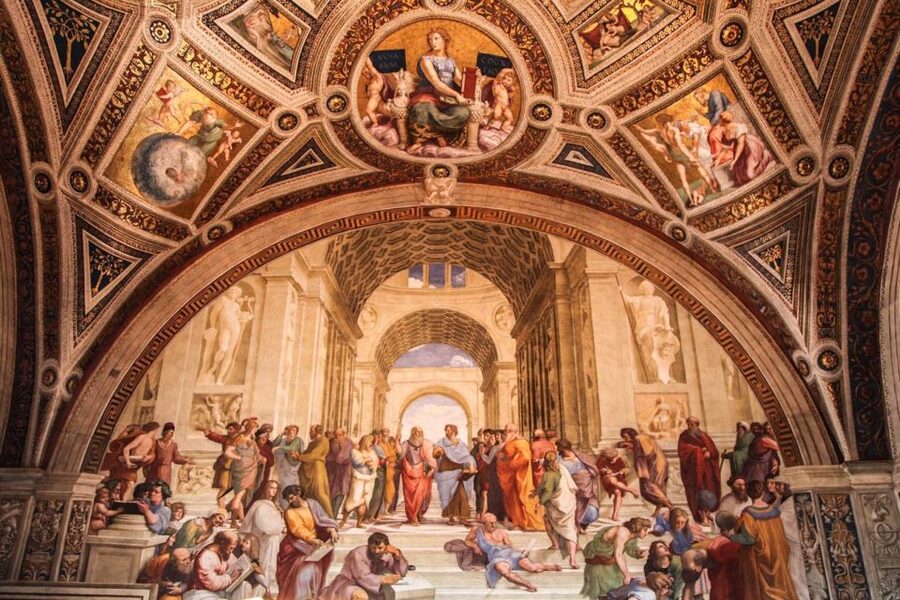
The Raphael Rooms are among the tour’s main artistic rewards. Raphael and his workshop decorated these rooms for the papal court, filling them with scenes that connect theology, philosophy, power, and classical learning.
Your guide can place the frescoes in the setting of the Italian Renaissance, when artists, scholars, and popes competed to define the culture of Rome. You will also hear how Raphael and Michelangelo worked in the same broad period, sometimes as rivals and always as artists responding to the achievements around them.
The rooms reward patient looking. Instead of taking a quick photo and moving on, spend time with the arrangement of figures and the way Raphael balances large groups. The paintings are not only pretty walls. They present a vision of knowledge, faith, and authority.
A private visit is useful here because you can ask about a particular figure or scene. If you care about painting more than church architecture, tell your guide early. The tour is designed to be adjusted to your interests, although the exact amount of time at each stop will depend on the guide and the day’s conditions.
The Sistine Chapel and Michelangelo’s grand vision
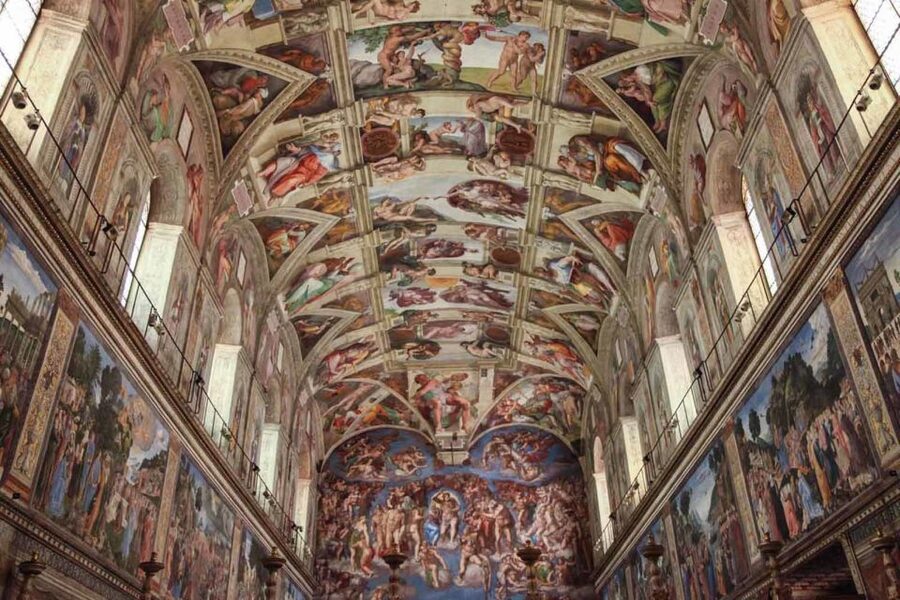
The Sistine Chapel is scheduled for about 20 minutes, which is short considering the amount of art overhead. The purpose of the guide’s explanation is to help you use those minutes well.
The ceiling presents scenes from the Book of Genesis, including Jonah, Adam, Eve, and Noah. Michelangelo arranged these figures across a vast architectural framework, giving the ceiling movement and structure even when you are standing far below it.
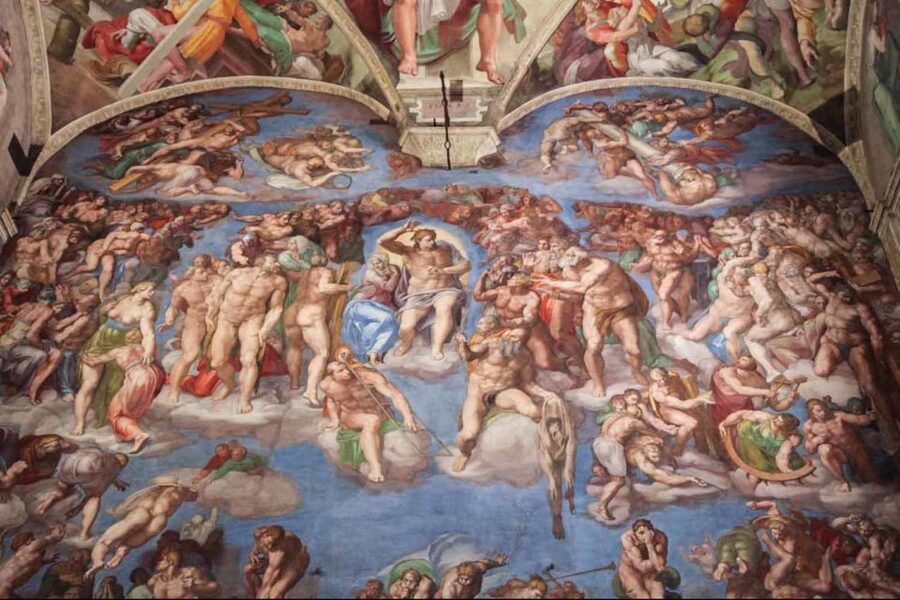
The Last Judgment covers the altar wall. Your guide can explain how the figures fit into Michelangelo’s ideas about humanity, faith, fear, and redemption. The frescoes changed the course of Western art, but you do not need a long lecture to appreciate their force. You need a few clear pointers before entering, then time to look up quietly.
Rules inside the chapel matter. Keep your shoulders and knees covered, follow the instructions about conduct, and do not count on treating the chapel like an ordinary museum room. Photography restrictions and other chapel rules may apply, so listen to the staff and guide.
The chapel can be crowded and noisy outside the quiet areas. That is the main weakness of even an expensive Vatican visit. A private guide cannot empty the room, but can give you a better framework for seeing what is directly in front of you.
Ancient sculpture that shaped Michelangelo and Raphael
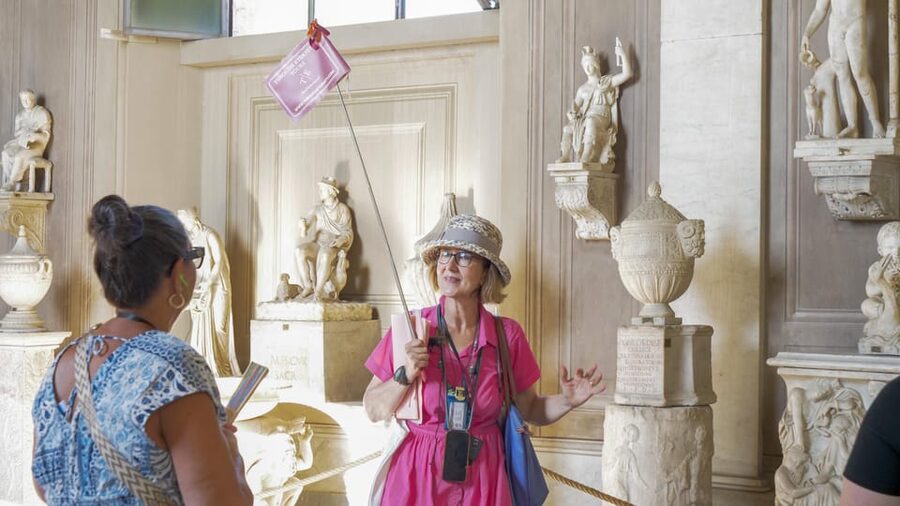
The ancient collection is not an optional side story. It helps explain why Renaissance artists worked the way they did.
The Laocoon, Apollo Belvedere, and Belvedere Torso are central examples. These Greek and Roman works were excavated and studied during the same age in which Michelangelo and Raphael were developing their own art. Their twisting bodies, strong muscles, and dramatic poses became a living school for Renaissance artists.
The Belvedere Torso is especially useful for understanding Michelangelo’s interest in the body. Even a fragment can suggest powerful movement. The Laocoon shows pain and struggle in a group of figures, while Apollo Belvedere presents a more controlled ideal of beauty.
You are not simply seeing old statues in glass or behind ropes. You are seeing the source material that Renaissance artists examined, admired, and adapted. Ask your guide to point out the links between a classical pose and a later fresco or sculpture. That connection is one of the tour’s best teaching moments.
The Pinecone Courtyard and Belvedere Courtyard add architectural scale to the visit. These spaces help you understand how the Vatican displayed ancient art in relation to gardens, courtyards, and monumental buildings, rather than as isolated objects in a modern gallery.
St. Peter’s Basilica, the powerful final hour
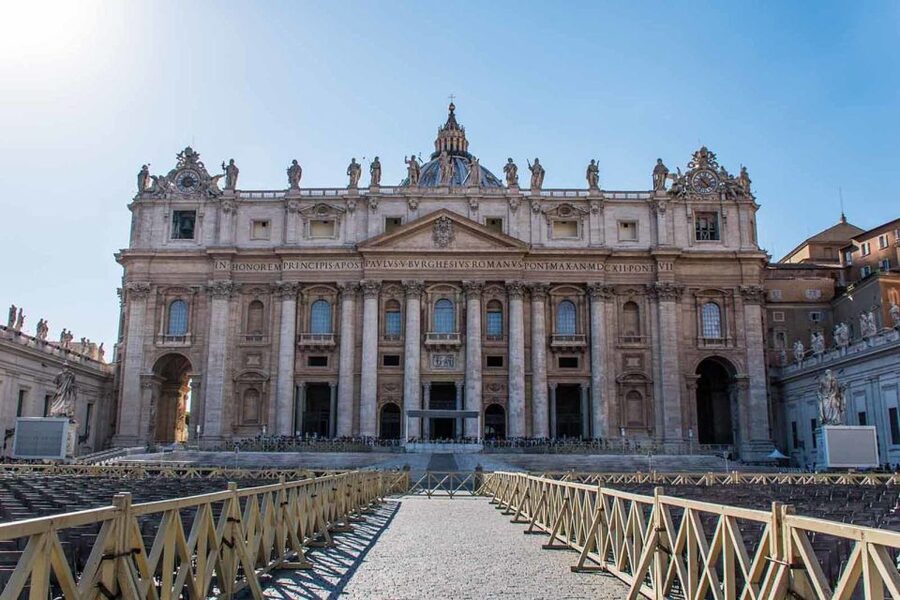
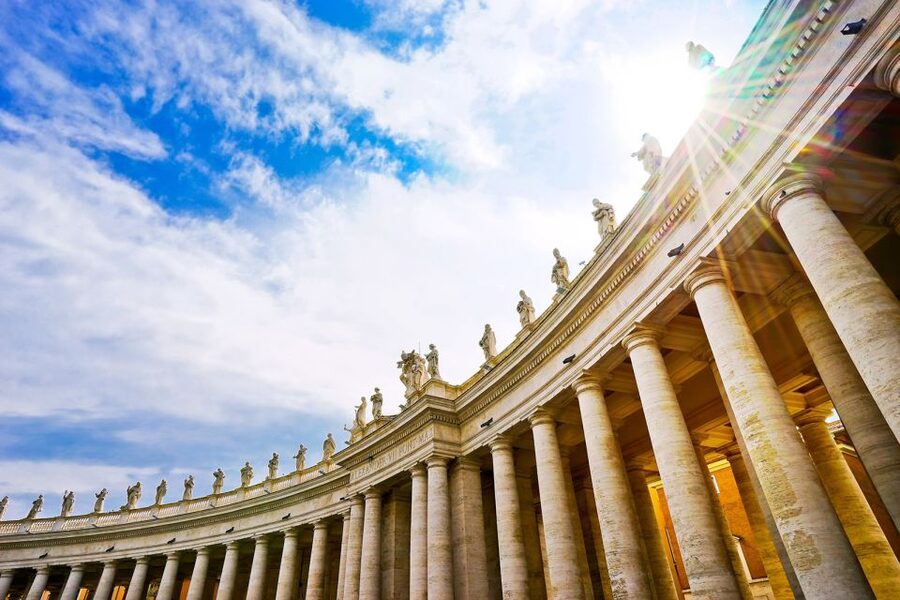
The tour ends in St. Peter’s Basilica, the symbolic and emotional high point for many people. Fast-track entrance matters here because the basilica can attract long lines, and the church is large enough that a first visit can feel scattered without a plan.
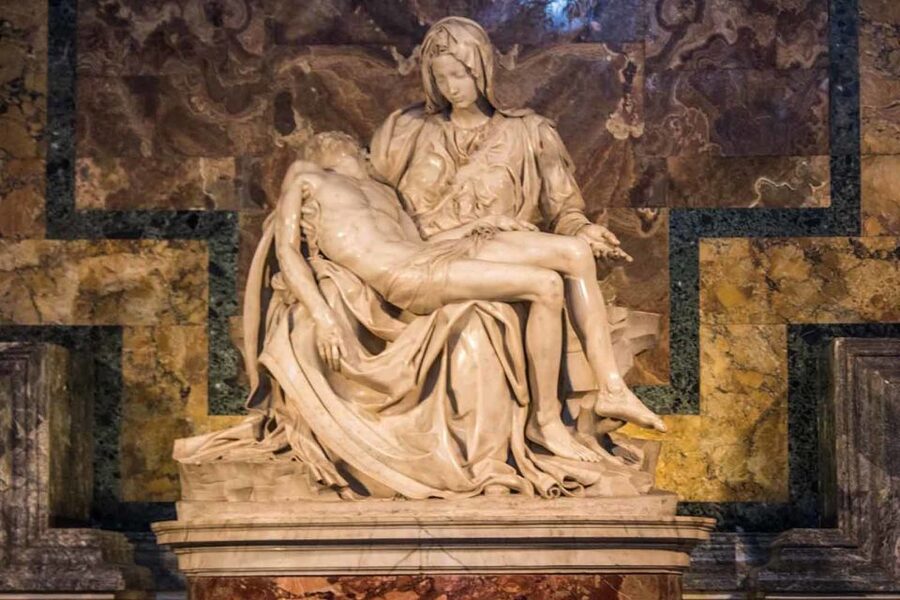
Inside, the focus includes Michelangelo’s Pietà, the sculpture of Mary holding the body of Christ, and Bernini’s monumental canopy above the main altar. The Pietà brings the tour back to Michelangelo, but in a different mood from the Sistine Chapel. Its quiet grief and polished marble ask for close attention.
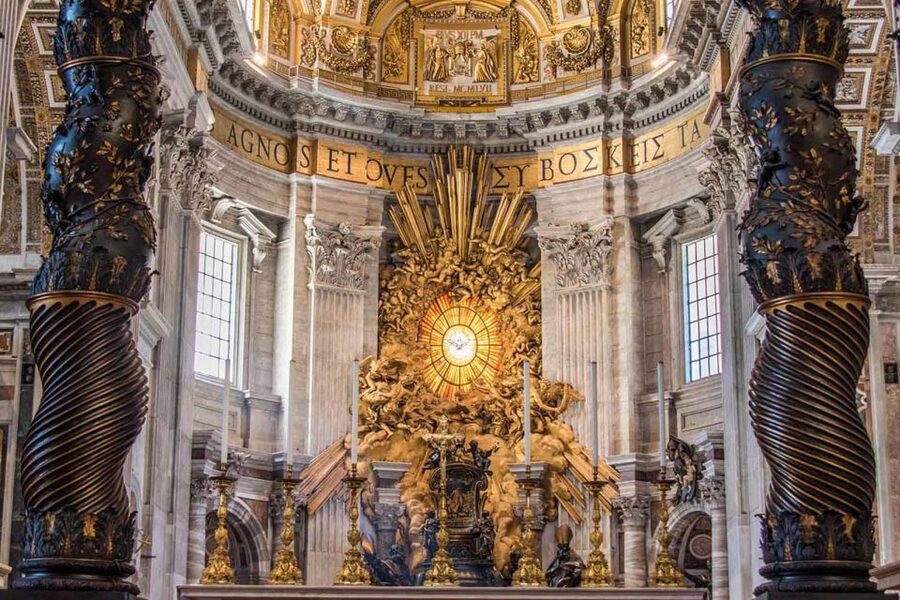
Bernini’s canopy, or baldacchino, gives the central altar a vast architectural frame. Look upward and then outward to understand the scale of the church. The building is meant to overwhelm you, but your guide can connect that scale to the importance of St. Peter’s tomb and the long development of the basilica.
The visit also touches on relics and religious tokens accumulated over nearly 2,000 years at the site associated with St. Peter. This is where the tour shifts from art history to the living center of Catholic Christianity.
One practical point needs checking before you book: the main description places the finish at St. Peter’s Basilica, while the meeting information also says the activity ends back at the meeting point. Confirm the exact exit arrangement with Through Eternity Tours, especially if you have dinner reservations or a timed train.
Walking demands, clothing, and access
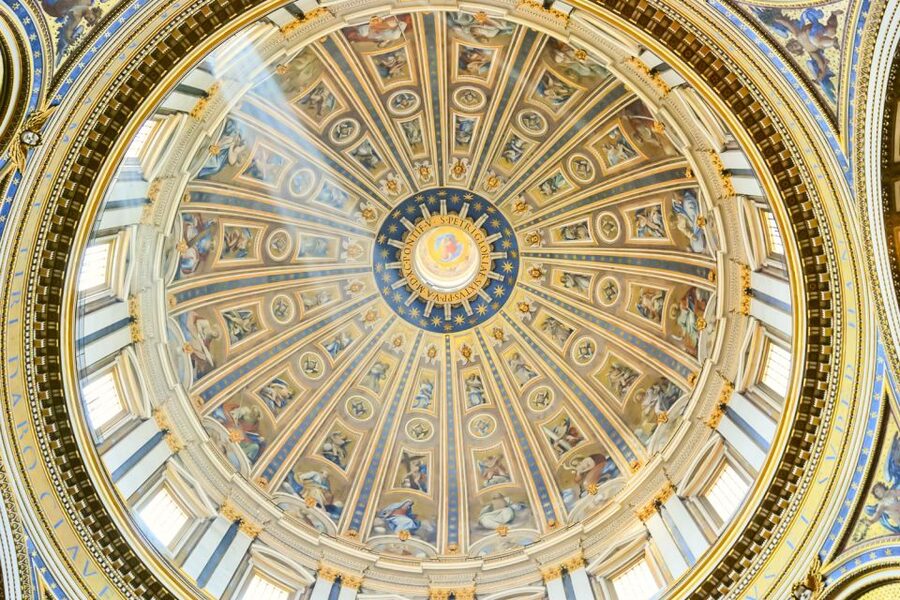
This is a walking tour with steps and staircases. It is listed as wheelchair accessible, but you should still tell the operator about mobility concerns when booking so the route can be handled properly.
The Vatican Museums can be tiring simply because of their scale. Five hours is a long stretch for anyone who is not used to standing and walking through galleries. Water and supportive shoes will help more than fashionable footwear.
The tour is offered in English and Italian. It is a private group experience, so you have more control than you would on a large group tour. That does not mean the museums will be quiet or uncrowded. It means your guide can respond to your questions and explain the art at your pace when conditions permit.
During the Jubilee period, some monuments may be under restoration. Parts of the route could change, so read any messages sent before the visit.
Visitors who meet Vatican City requirements for at least 74 percent disability may receive free museum entrance with the proper certification. If assistance from another person is required, that person also receives free entrance. Tell the operator when booking so the ticket cost can be removed from the price.
Who should book this Vatican tour?
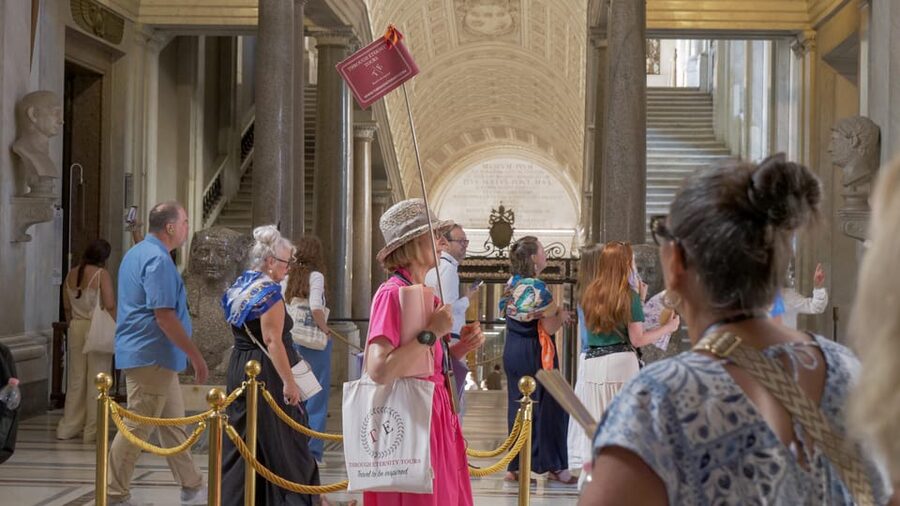
I would choose this experience if you want the Vatican to make sense, not merely to see the famous rooms. It suits first-time visitors who care about art, people who want a private guide rather than a large group, and anyone who finds Renaissance painting or ancient sculpture hard to read without help.
It is also a strong fit for families or mixed-interest groups because the route can be adjusted. One person can ask about Michelangelo, another about ancient Greek sculpture, and another about the history of the church.
I would think twice if $568 per person strains your Rome budget. You could spend less with a standard group visit or self-guided entry, though you would give up the private attention and special Pinacoteca focus. I would also avoid scheduling this immediately after another major walking tour.
The free cancellation policy allows cancellation up to 24 hours in advance for a full refund, and reserve-now-pay-later booking keeps payment until later. Those terms help if your Rome plans are still shifting, but they do not change the basic question of value.
My verdict: a costly but serious Vatican experience
Book this tour if you want expert help connecting the Vatican’s paintings, sculpture, architecture, and Christian meaning. The best parts are the private guide, the ancient sculpture collection, the Pinacoteca visit, and the clear artistic path from Greek masterpieces to Michelangelo and Raphael.
Skip it if you mainly want quick access to the Sistine Chapel at the lowest price. For everyone else, the $568 cost is justified only when you will use the guide actively: ask questions, request context, and say what interests you before the tour begins. Brandon, Guia, Tatiana, and Thomas have all been praised for turning the visit into a focused lesson rather than a march through famous rooms, and that is exactly what you are paying for.
FAQ
How long does the private Vatican tour last?
The tour lasts five hours. The Vatican Museums portion is scheduled for about three hours and 40 minutes, the Sistine Chapel visit for about 20 minutes, and St. Peter’s Basilica for about one hour.
What is the price?
The listed price is $568 per person.
Is the tour private?
Yes. This is a private group activity, so the guide can adjust the visit around your interests.
Which languages are available?
The tour is offered in English and Italian.
Where does the tour begin?
Your guide meets you in front of Café Vaticano at Viale Vaticano 100. Look for a Through Eternity sign or flag.
Where does the tour finish?
The main route finishes at St. Peter’s Basilica. The meeting information also says the activity ends back at the meeting point, so confirm the exact ending arrangement before the visit.
Is skip-the-line access included?
Yes. The tour includes skip-the-line access to the Vatican Museums and fast-track entrance to St. Peter’s Basilica.
What identification do I need?
Each person must present a valid passport or government issued photo ID. The name must match the name provided at booking.
What should I wear?
Your knees and shoulders must be covered. Shorts and sleeveless shirts are not allowed, so choose modest clothing suitable for places of worship.
Is the tour wheelchair accessible?
The activity is listed as wheelchair accessible. Tell the operator about any mobility concerns when booking because the tour includes walking, steps, and staircases.
Recently added around Rome
- Rome: VIP Colosseum, Roman Forum, Palatine Hill Experience★ 4.1 · 16 reviews
- Rome: Gourmet Wine and Dine in a Luxury Restaurant★ 4.9 · 12 reviews
- Rome: Vatican Museums & Sistine Chapel VIP Tour★ 4.1 · 35 reviews
- Rome: Vatican and Sistine Chapel Tour with VIP Entrance★ 4.7 · 67 reviews
- Rome VIP Private Golf Cart Experience★ 4.8 · 39 reviews
- Rome: Appian Way and Catacombs VIP Tour with Hotel Pickup★ 4.8 · 25 reviews
- Rome: 2-Hour Vip Tuk-tuk tour with Hotel Pickup and Prosecco★ 5.0 · 92 reviews
- Rome: Castel Sant’Angelo and Hadrian’s Tomb Guided VIP Tour★ 4.4 · 14 reviews
VIP Experiences, compared.
Desert Safari with VIP BBQ and Optional Quad Bike
Read our review →
Cu Chi Tunnels & Mekong Delta Tour with VIP Limousine Transfer
Read our review →
Legendary Venice: Doge’s Palace, St Mark’s & VIP Terrace Access
Read our review →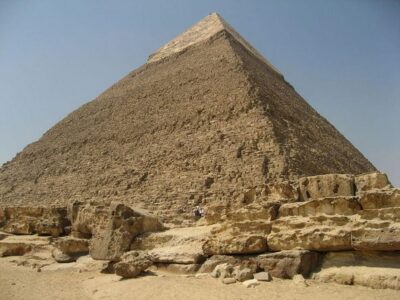
VIP All inclusive Best of the best Giza Pyramids,Sakkara,Memphis
Read our review →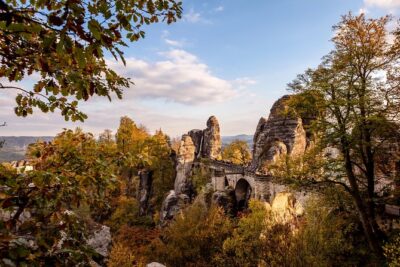
VIP Best Reviews: Bohemian & Saxon Switzerland from Prague
Read our review →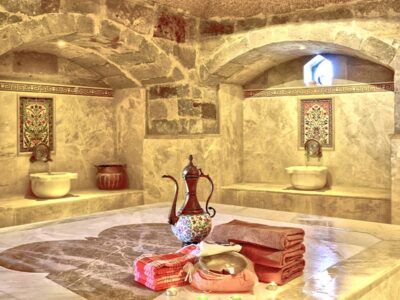
Luxury VIP Hammam & Spa with Transfer & Drink
Read our review →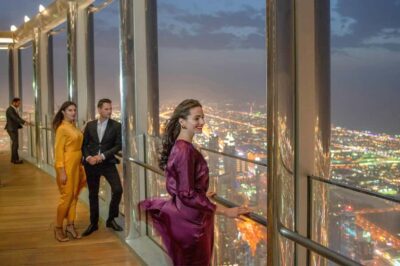
Burj Khalifa VIP Experience Level 152 Lounge Access
Read our review →
Premium Neuschwanstein Castle and Linderhof VIP Tour from Munich
Read our review →Browse the lists this tour appears in