
Review · ITALY
Pompeii VIP 3h Tour: Skip-the-line with your Archaeologist
Pompeii’s most powerful moments are not only its grand temples. They are the small clues: a coin that changed the accepted date of the eruption, a heavy gold arm cuff, household objects, and plaster body moulds showing people caught in the disaster. This private three-hour tour with an archaeologist gives those details a human setting instead of leaving you to wander among the ruins without context.
I like the private format, since you can stay with your own group and hear a guide clearly. I also like the route itself: it covers major public buildings, several houses, the baths, the theaters, the Garden of the Fugitives, and the amphitheater. The main consideration is the price, listed at $407.83 for a group of up to one, so it makes the most sense if expert guidance and personal attention matter more to you than finding the cheapest Pompeii entrance.
Key points at a glance
- A private archaeologist leads the visit: The guide is a licensed local expert, with tours available in English, French, Spanish, and Italian.
- The route covers Pompeii’s major sights: You visit the forum, Basilica, temples, market, baths, houses, theaters, Garden of the Fugitives, and amphitheater.
- Recently opened houses are included: The route features homes such as the House of Golden Cupids and the House of Menander.
- Admission and skip-the-line service are included: You do not need to arrange a separate entrance ticket.
- The meeting point is specific: Meet at Porta Marina Superiore, directly in front of the Hortus Bar.
- Personal ID is required: Every participant’s full name must be placed on the ticket, and each person must bring an original passport or ID.
Why an archaeologist changes your Pompeii visit
Pompeii is large, exposed, and easy to underestimate. You can walk past a temple, bakery, bath complex, or private home in seconds without knowing what made it important. A good guide gives the stones a purpose. This tour is built around that idea, using objects, buildings, and small details to explain how the city worked before the eruption.
The antiquarium is an especially useful opening stop. Here, your guide can show objects recovered in recent excavations, including the coin linked to a revised understanding of the eruption date and a substantial gold arm cuff. These are not just attractive museum pieces. They show how ongoing excavation can change what we think we know about Pompeii.
The guide also connects archaeological evidence to everyday life. You’ll move from public spaces into private houses, from political buildings to bathing facilities, and from entertainment venues to the final places where people tried to escape. That range is valuable because Pompeii becomes more than a frozen disaster scene. You see a functioning Roman city with politics, commerce, religion, leisure, and domestic life.
The strongest praise attached to the guiding comes from the clear academic background of Ricardo, who is described as a trained archaeologist, and from the memorable, science-focused visit led by Federica. Guide assignments can vary, so you should not assume one particular person will lead your departure. Still, the experience is designed around an archaeologist rather than a general escort.
More VIP Experiences in Italy
- Legendary Venice: Doge’s Palace, St Mark’s & VIP Terrace Access
★ 4.5 · 5,033 reviews - Rome: Colosseum Arena, Roman Forum & Palatine Hill VIP Tour
★ 4.5 · 3,674 reviews - VIP Vatican Breakfast and Guided Tour with Sistine Chapel Access
★ 4.5 · 1,796 reviews
Meeting at Porta Marina Superiore
The tour begins at Porta Marina Superiore, in front of the Hortus Bar. This is an important detail because Pompeii has more than one entrance, and arriving at the wrong gate could cost you valuable time. The activity ends back at the same meeting point.
Bring your original passport or ID. New ticket rules require the full name and surname of every person on the booking, including children, to appear on the ticket. Tickets are personal, so punctuality matters. If one member of your party arrives late or without the required identification, the group may face a serious problem at entry.
Transportation is not included. You need to make your own way to Pompeii and the stated meeting point. Food and drinks are also not included, so plan around the three-hour route rather than expecting refreshments along the way.
Entering Pompeii through the ancient gateway
After meeting your guide, you enter through the Porta Marina area, one of Pompeii’s principal ancient gateways. The route begins with the physical remains of the entrance and a view toward Mount Vesuvius, the volcano that buried the city in AD 79.
That opening view gives the rest of the visit a clear frame. You are looking at the same volcano that shaped the city’s final day, but you are also entering through a place designed for ordinary movement and trade. The contrast between daily urban life and sudden catastrophe is present from the start.
The skip-the-line service is useful here. Pompeii can involve waiting at the ticket entrance, and a three-hour tour is already tightly planned. Skipping the ticket line does not mean skipping security or ignoring the time of your appointment, but it removes one avoidable delay.
Antiquarium objects and the evidence behind the story
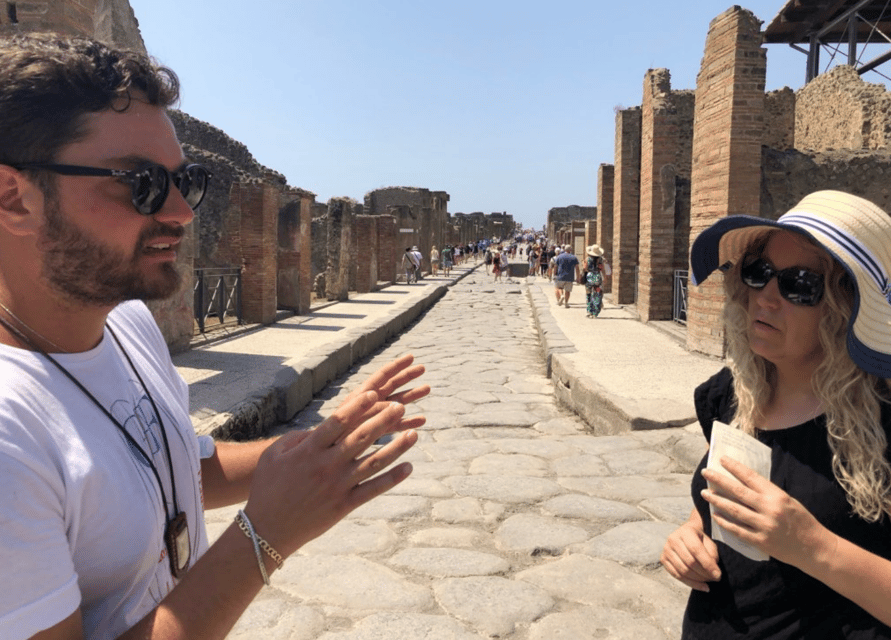
The antiquarium helps set this visit apart from a simple walk through the ruins. Your guide presents objects from recent excavations, including the coin associated with a changed understanding of when the eruption occurred and a heavy gold arm cuff.
These details matter because archaeology is not only about famous buildings. A coin can affect the dating of an event. A piece of jewelry can reveal wealth, taste, and the habits of the person who owned it. Your guide’s role is to connect those objects with the streets and houses you will see later.
The tour’s scientific side was especially praised in the feedback provided for this experience. If you want only postcard views, the antiquarium may feel like a slower start. If you want to understand how archaeological conclusions are formed, it is one of the most useful parts of the route.
Same destination, a different level of comfort:
- Colosseum, Roman Forum & Palatine Hill Guided Tour
★ 4.5 · 1,568 reviews - VIP Vatican, Sistine Chapel & St. Peter’s Basilica Guided Tour
★ 4.5 · 1,128 reviews - From Naples – VIP Tour with small groups on the Amalfi Coast
★ 4.8 · 895 reviews - Luxury catamaran from Porto Rafael-Palau to the Maddalena Archipelago
★ 5.0 · 751 reviews
Basilica, Forum, and the center of public life
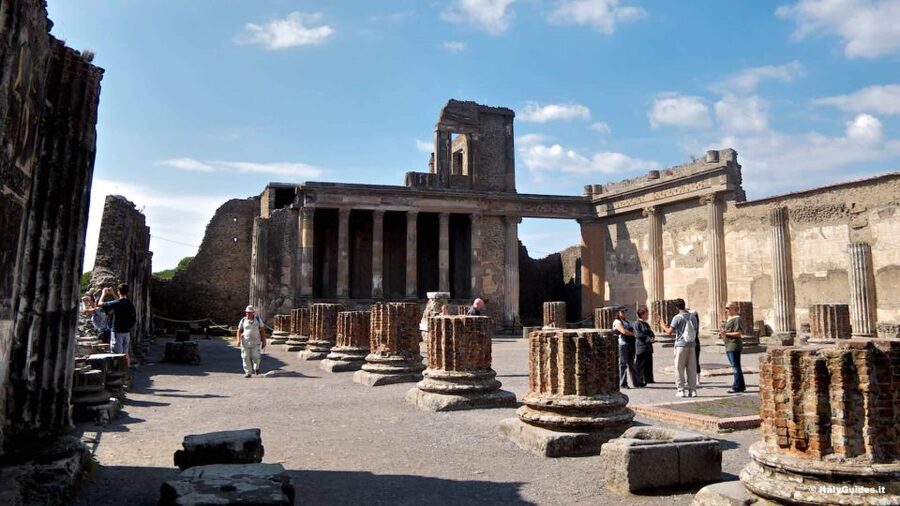
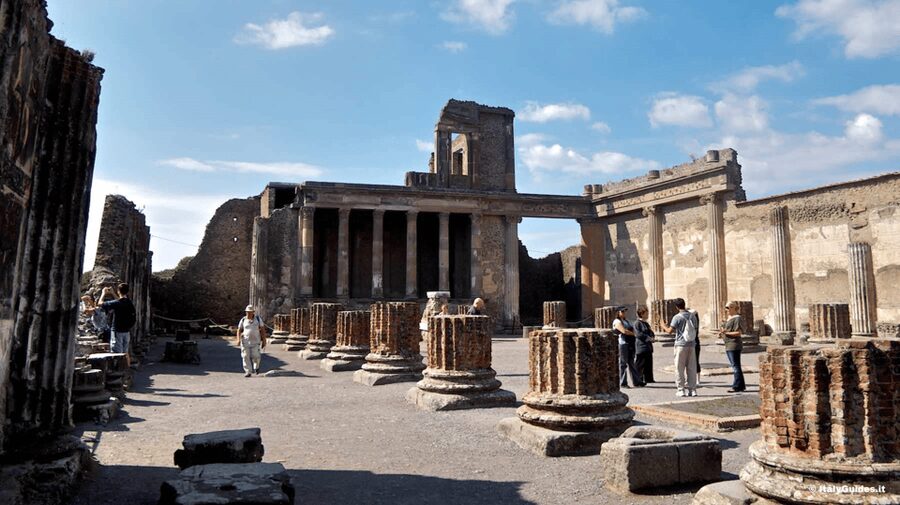
The Basilica and Foro Civile di Pompei bring you into the civic heart of the city. The Basilica was a major public building used for legal and commercial business. The forum nearby was the central open area, surrounded by important religious, political, and commercial buildings.
From here, you visit the Temple of Apollo and the Temple of Jupiter. These stops help explain the religious side of Roman public life, while the forum shows how closely religion, politics, law, and trade were placed together.
The Macellum, or market building, adds a more practical note. It was tied to food selling and daily commerce, giving you a chance to think about how Pompeii’s residents bought and handled ordinary goods. The Forum Baths then shift the focus to public bathing, a central part of Roman social life.
You should expect uneven ground, open sun, and plenty of walking through this section. The buildings are not presented as intact monuments. You are reading walls, columns, foundations, paving, and surviving decoration with help from the archaeologist.
Houses that reveal private Pompeii
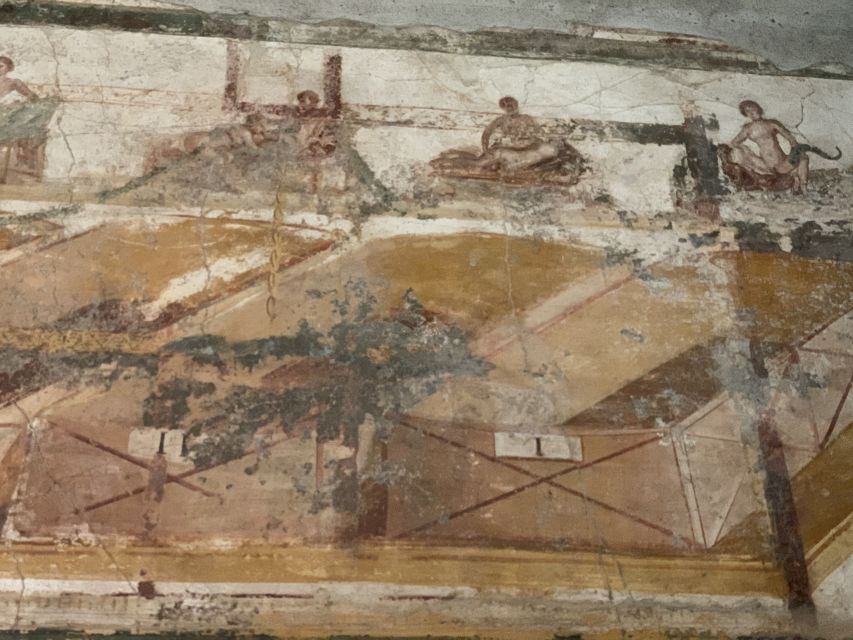
The private homes are among the most rewarding stops because they show how Roman families used space, decoration, gardens, and reception rooms. The route includes the House of the Tragic Poet and the House of Menander, as well as other attractive houses that have recently opened.
The House of the Tragic Poet is known for its domestic setting and decorative details. It gives the guide a chance to explain how a private home could also serve as a place for receiving guests and displaying status.
The House of Menander offers another look at upper-class domestic life. Its name comes from a decoration associated with the Greek playwright Menander. You can expect your guide to explain the layout and surviving features rather than treating the building as a quick photo stop.
The House of Golden Cupids is another highlight because it represents the continuing work of restoration and access at Pompeii. Recently opened houses can be a major reason to choose a guided route. Without help, you may not know which rooms are newly available or why a particular house deserves your attention.
The drawback is that access to individual houses can depend on the park’s operating conditions. The tour description includes these homes, but archaeological sites sometimes adjust access for conservation or restoration. Your guide can help you make sense of the route if a specific room is closed.
Via dell’Abbondanza and the Roman daily routine
The walk along Via dell’Abbondanza shifts the visit from grand public buildings to an urban street. This was one of Pompeii’s main roads, and it helps you picture movement through the city, from homes to shops and public spaces.
Your guide can use the street to explain how Pompeii functioned as a lived-in place. Look for changes in building size, doorways, paving, and the relationship between homes and commercial areas. The value here is not one single monument. It is the way the street links many parts of the city.
This is also where comfortable shoes become essential. Pompeii’s surfaces can be rough, and the tour keeps moving for three hours. Wear practical clothes and bring sunscreen, especially because much of the route is outdoors.
The Lupanare and the Forum Baths
The Lupanare is one of Pompeii’s most talked-about buildings. Its presence can attract a lot of attention, but the important point is how it fits into the wider city. Your guide can explain the building within Roman urban life rather than leaving it as a sensational stop.
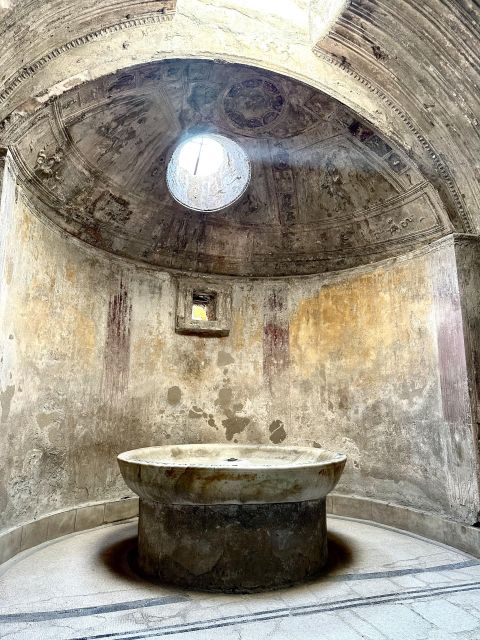
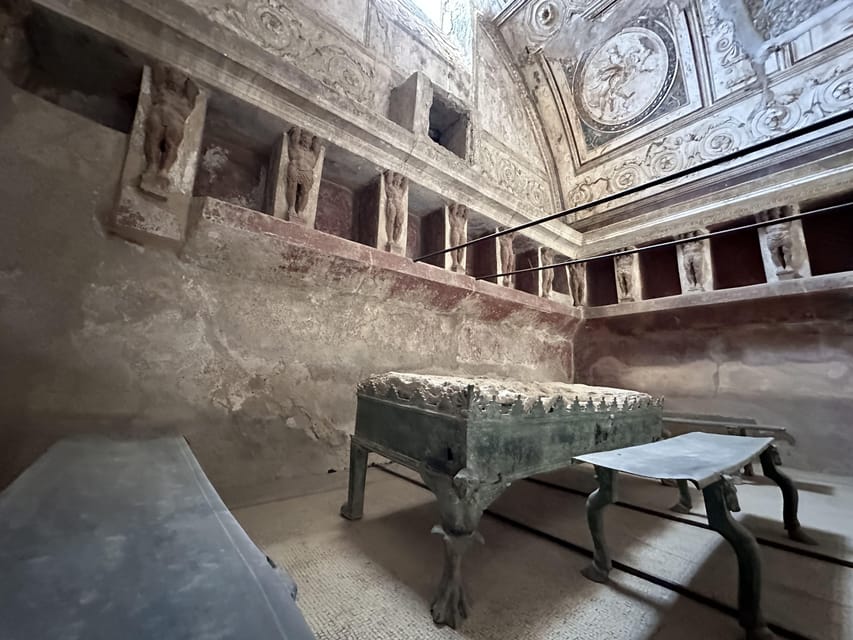
The Forum Baths offer a different view of public routine. Roman baths were places for washing, exercise, social contact, and leisure. Their rooms and heating arrangements show the level of planning needed to create a comfortable public facility in an ancient city.
These stops are compact compared with the forum and amphitheater, but they add balance. You are not spending the whole tour on monumental architecture. You are also seeing the buildings connected to ordinary habits and social behavior.
The Garden of the Fugitives
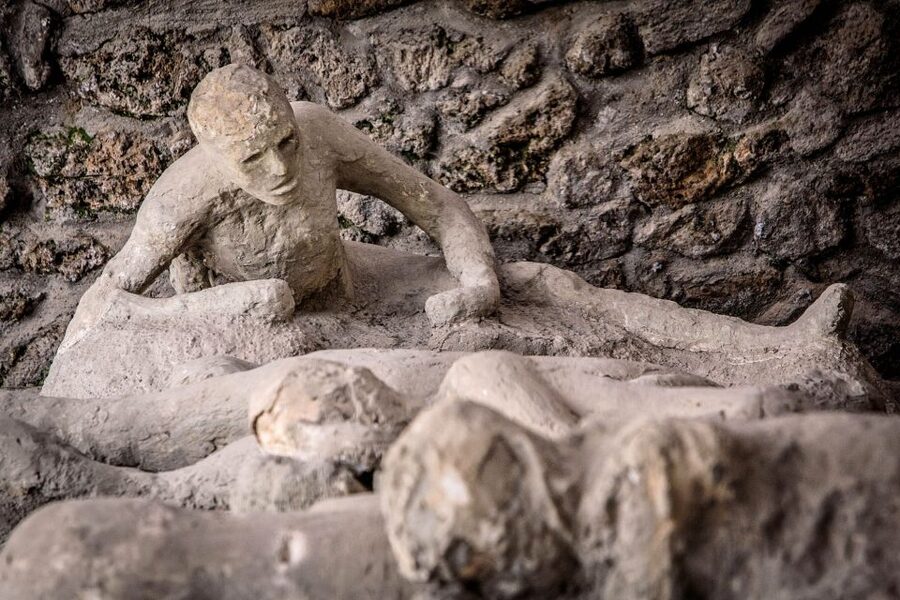
The Garden of the Fugitives is one of the most difficult and important parts of the tour. During the eruption, people tried to escape through this area but died there. The body moulds preserve the shapes of some victims.
This stop can be emotionally heavy. The moulds are not simply archaeological displays. They are physical evidence of individual deaths, and your guide’s explanation helps place them in the sequence of the eruption without turning the moment into spectacle.
I would give this part your full attention. It is one of the clearest reminders that Pompeii was a real city filled with real people, not an abandoned stage set. If you are visiting with children, consider how they may respond to seeing the moulds.
The Great Gymnasium and the city’s objects
The Great Gymnasium adds another public dimension to the route. Here, daily objects are displayed, giving you a closer look at the material side of Pompeii.
These objects help bridge the gap between large ruins and individual lives. Walls and columns show how a city was built. Household and personal objects show how people used it. The stop also gives your guide another opportunity to explain what excavation can reveal beyond architecture.
Because the tour includes both the antiquarium and the Great Gymnasium, you receive more than a procession past famous ruins. Objects remain central to the explanation. That is a strong reason to choose this tour if you want archaeology rather than only a general overview.
The theaters and final stop at the amphitheater
The route includes the Large Theatre and ends at the Amphitheater of Pompeii. The Large Theatre shows the city’s interest in performance and public entertainment. Its shape makes more sense with a guide who can explain how audiences used the space and how it fit into the city.
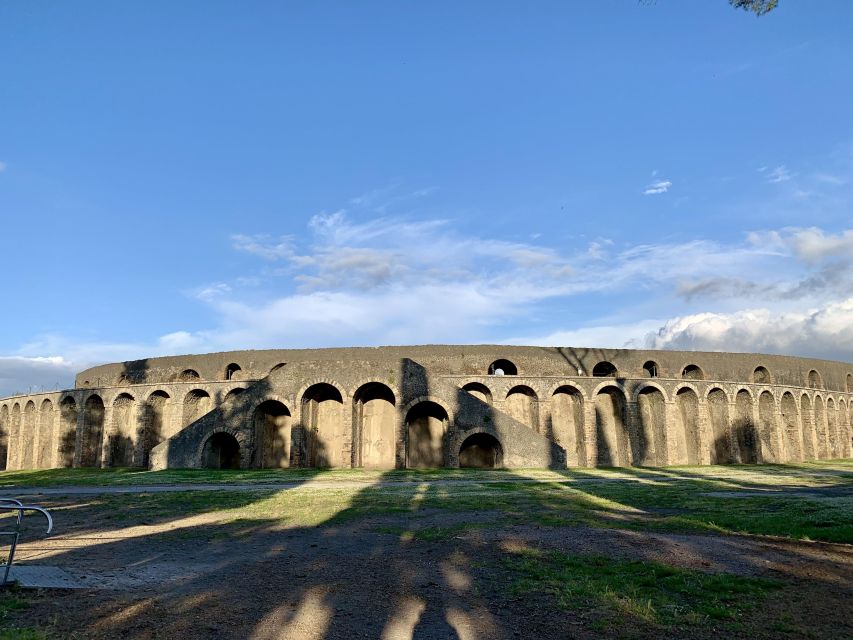
The amphitheater provides a fitting final stop. It was built for large public spectacles and could hold a substantial crowd. After seeing Pompeii’s civic center, homes, baths, streets, and places of worship, the amphitheater brings you back to the city’s shared public life.
Ending here gives the route a strong arc. You begin at the entrance and antiquarium, pass through the city’s institutions and homes, confront the eruption’s victims, and finish in one of its major venues. The tour then returns to the meeting point at Porta Marina Superiore.
Is $407.83 good value?
The listed price is $407.83 for a group of up to one, which makes this a premium Pompeii experience. The value depends on what you want from the visit. Admission, skip-the-line service, private guiding, full assistance, and a personal archaeologist are included.
For a solo visitor, the price may feel high compared with entering Pompeii independently. You are paying for a private professional rather than simply for access to the ruins. That can be worthwhile if you want an organized route through a huge site, an expert explanation of the excavations, and the chance to ask questions as you go.
The value improves if you are comparing it with arranging a separate ticket, guide, and route on your own. You also avoid spending precious time deciding which parts of Pompeii to prioritize. The route is broad and includes several recently opened houses, which can be difficult to identify without local assistance.
If your main goal is a low-cost visit or a slow day of wandering alone, this is probably not the best match. If Pompeii is a major reason for your trip and you want the ruins interpreted by an archaeologist, the higher price is easier to justify.
Who should book this Pompeii tour?
I would choose this tour for a first visit, especially if you have only half a day in Pompeii and want to see the major areas in a clear order. It also suits anyone interested in archaeology, Roman domestic life, excavation methods, and the evidence behind the eruption story.
The private format works well for couples, families, or a small personal group that wants direct contact with the guide. The tour is listed as wheelchair accessible, though Pompeii’s ancient surfaces and changing conditions still make it sensible to confirm the practical route when booking.
It may be less suitable if you dislike a fixed three-hour schedule, want to explore at your own pace, or are mainly looking for the lowest possible price. Pompeii requires walking, sunscreen, and comfortable clothing, and the emotional stop at the Garden of the Fugitives is not easy for everyone.
Free cancellation is available up to 24 hours before the activity, and you can reserve now and pay later. Those policies help if your Campania plans are still shifting, but the personal ticket rules make punctual arrival and correct identification especially important.
FAQ
How long does the Pompeii tour last?
The tour lasts three hours.
Where does the tour begin?
You meet at Porta Marina Superiore, directly in front of the Hortus Bar.
Where does the tour end?
The activity ends back at the meeting point at Porta Marina Superiore.
Is admission to Pompeii included?
Yes. Admission tickets are included in the tour price.
Does the tour include skip-the-line entry?
Yes. Skip-the-line ticket service is included.
Is the tour private?
Yes. It is a private group tour with a personal archaeologist.
Which languages are available?
The live tour guide service is available in English, French, Spanish, and Italian.
Is transportation included?
No. Transportation to and from Pompeii is not included.
What identification should I bring?
Bring an original passport or ID. The full name and surname of every participant, including children, must appear on the personal ticket.
Can I cancel for a full refund?
Yes. You can cancel up to 24 hours in advance for a full refund.
Should you book it?
Book this tour if you want Pompeii explained by an archaeologist rather than visited as a collection of ruins. The route covers the city’s central buildings, private houses, baths, theaters, Garden of the Fugitives, and amphitheater, while the antiquarium and Great Gymnasium add useful archaeological evidence.
I would skip it if your priority is the lowest entrance cost or complete freedom to roam. For everyone else, especially first-time visitors with limited time, the private format, included admission, and strong focus on excavation make the price easier to defend. Bring your ID, arrive at Porta Marina Superiore on time, wear good shoes, and be ready for a serious but rewarding look at Pompeii.
More three-hour bookings in Italy
- Cagliari 3 Hours Luxury Motorboat Tour – Wine and Snorkeling
★ 5.0 · 118 reviews - Three Hour Private Guided Tour of Capri with a luxury Gozzo cabin cruiser
★ 5.0 · 15 reviews - Dubai 3 Hour Private Luxury Yacht Charter with Jet Ski Option
★ 5.0 · 886 reviews - Las Vegas: 3-Hour VIP Hoover Dam Small-Group Mini Tour
★ 4.8 · 716 reviews
More skip-the-line entries in Italy
- Madrid: Royal Palace VIP Tour with Skip-the-Line Ticket
★ 4.3 · 645 reviews - Sagrada Familia VIP Tour Skip the Line with Small Group
★ 5.0 · 359 reviews - Taj Mahal skip the line luxury tour with guide
★ 5.0 · 241 reviews - Skip the Line – Private Same Day Agra Tour by Luxury Car
★ 5.0 · 65 reviews
Recently added around Italy
- PRIVATE WINE TOUR TUSCANY Chianti Wineries, Expert English driver★ 5.0 · 57 reviews
- VIP Private Tour Florence Cathedral Dome & Monuments★ 4.5 · 20 reviews
- VIP PRIORITY ACCESS: UFFIZI GALLERY- Guided Tour★ 4.5 · 42 reviews
- San Gimignano and Volterra Tour by Private Luxury Van★ 4.5 · 6 reviews
- VIP Priority Access: Uffizi Gallery- Guided Experience★ 4.5 · 94 reviews
- Florence: Luxury Duomo Cathedral Private Walking Tour★ 4.0 · 29 reviews
- Florence: Vip early Timed Entry Ticket Uffizi Gallery★ 5.0 · 34 reviews
- Uffizi Gallery Guided VIP Small Group Experience★ 4.5 · 29 reviews
VIP Experiences, compared.

Desert Safari with VIP BBQ and Optional Quad Bike
Read our review →
Cu Chi Tunnels & Mekong Delta Tour with VIP Limousine Transfer
Read our review →
Legendary Venice: Doge’s Palace, St Mark’s & VIP Terrace Access
Read our review →
VIP All inclusive Best of the best Giza Pyramids,Sakkara,Memphis
Read our review →
VIP Best Reviews: Bohemian & Saxon Switzerland from Prague
Read our review →
Luxury VIP Hammam & Spa with Transfer & Drink
Read our review →
Burj Khalifa VIP Experience Level 152 Lounge Access
Read our review →
Premium Neuschwanstein Castle and Linderhof VIP Tour from Munich
Read our review →Browse the lists this tour appears in